Tuesday, May 29, 2012

French Studies


watercolour and pencil


Bonjour! Madam and I are just back from a short jaunt in Northern France. As well as a bit of a holiday, we explored the landscape further than Google Streetview allows, and saw a couple of features I’d used in paintings. The Nord Pas–de–Calais is a national park area, and very varied – high flat plateaux, rolling downs, densely hedged valleys, and seaside beaches and cliffs, plus a nice variety of cheeses.

Our first pre-planned location was the site of Wreck No.5. Bien sur, there was the track curving round up the hill, and the higher ground further away, but the central clump of trees – gone!!! Only a small elder bush remained, a re-growth from the culling. Quelle horreur!

The second was where I had found a herd of white cattle - the models for Wreck No.7 - and in that very same field, there they were, young and pristine. Merveilleux!. They weren’t the actual animals in the painting (those were long gone) but it was SO good to see my inspirational Vaches Blanches there, and more beautiful. Cows are curious, but these ones walked straight down the field, and stood looking at me over the fence as I babbled away to them. Eventually we had to drive away, and as They stood watching us leaving the valley, my eyes were, well… un peu blurry.

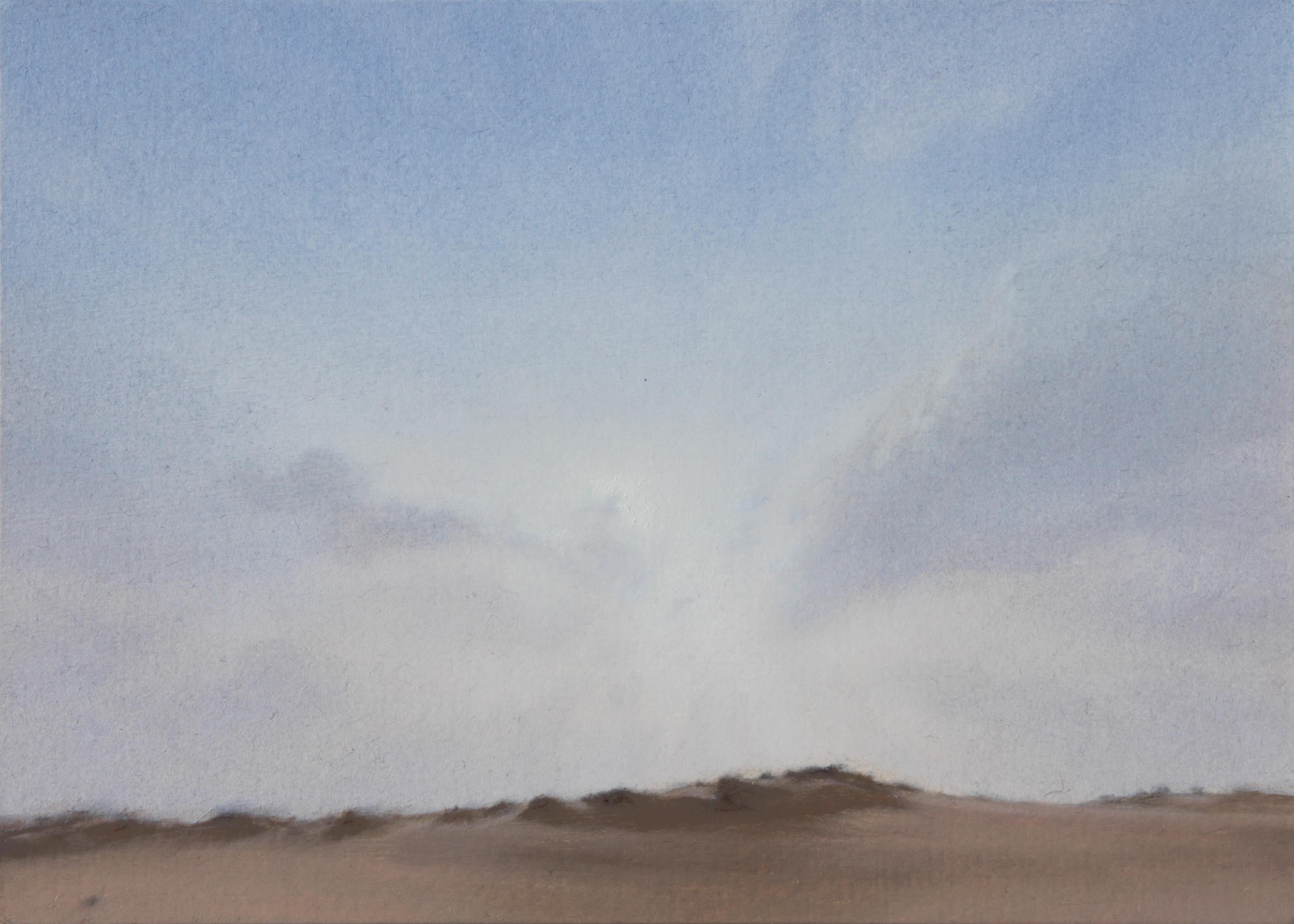
The French Studies? Alors, les vacances is maybe not the best time to be pursuing l’excellence artistique. The watercolour is of the Wimille valley, done late on a VERY windy afternoon. C’est mon excuse. 

The pencil cows are just the black and white Fresians (sketches of My Vaches Blanches were, frankly, pas bien) next to where we stayed. Sketching them with my super-duper finely-graded factory-made lead as they browsed around the field, I couldn’t help thinking about those ancient Gallic cave-dwellers who drew wild lunging bull aurochs and deer in soot and ochre…

…and how they did it so much better.

Thursday, April 26, 2012

Sky Template Sketches


watercolour and gouache

I spend a long time looking at clouds. They are ethereal and mysterious and enthralling, and I draw them from life to try to understand how they work.

But… I’ve become aware that my cloud sketches sometimes lack context and scale. Looking at them later they seem to just hang in space, which is a shame.

As most of these little sketches are from our front window the roofline is constant, so I photoshopped some templates and printed them onto heavy-ish copy paper. Now, when I see an interesting sky forming, I just pick a pre-printed sheet and off we go. They’re quite small, 10-20cm across, so they get done very fast, and as the printed areas are narrow-toned mid-grey it’s very easy to modify them to the light of the time.

These are a few of the more successful ones.

However, there is a problem with this computerised convenience in that the printer paper is way too thin for extended water work. It’s also a bright cool white, which means that any gouache white comes across as creamy yellow. I’ve been trying lino and wood block skylines printed onto heavier paper, but unfortunately there’s a problem with that too – the results are a bit rubbish. Which is also a shame

It may be just a technique problem and I’ll persevere, but if it proves too much of a headache I’ll ignore the damned context issue and go back to studying the clouds floating free again.

MMMmmmmmm……   Clouds floating free…

Friday, March 30, 2012

Wreck No.10


oil on papered canvas 31x25cm

At last, the first finished painting this year. There’s nothing subtle about the composition, but I’m quite pleased with the paint handling.

The wreck itself is done with streaky thin paint. It’s thinned with turpentine plus a touch of linseed oil, and the hard edges are cut back using a firm chisel-edged brush and turpentine. There’s very little opaque paint here, and what is there is thin and surprisingly orange (thin pale paint tends to go blue-ish on top of darks – something learned disguising glue lines in my antique restoration days).

I tried all sorts of oily paint/blending/glaze effects to get a strong light on the earth and sky, which may or may not actually be as effective as the idea in my head, and may be overworked. What is definitely successful is the overall contrast between the wreck and its setting – light/dark, light/heavy, soft/hard, and in this case oily/lean.

Just to follow up January’s post with SSA/VAS show: It was on during February and many good words were spoken about my pieces – by fellow painters – which was quite a boost, and it’s very healthy to have my profile raised a bit. The Union Gallery have also given me a huge boost of encouragement (which almost brought on a swoon), and some good advice about the gallery scene, which, with a bit of luck, may lead to more exposure.

All this positivity is all very well, but there’s a part of me (the greying mousy-brown bit) that suspects that it only came about because I am still blond from last year’s Punk Xmas.

Lord only knows what would have happened if I’d not been wearing glasses…

Saturday, February 4, 2012

Sunset


watercolour and gouache 19x14cm

In the National Gallery of Scotland there is a collection of Turner’s watercolours, which go on show every January. It’s been decades since I last saw them, so last month Madam and I went and had a look.

Lovely to see them again, and I hadn’t previously recognised the range of styles – from rigidly controlled pointillism to ethereal washed-out layers. It was interesting to see how good his drawing is, and that it underpins even the loosest of atmospherics.

This time, unlike my younger self, I actually read the information cards, which listed the techniques and materials used. There was ‘scratching’ and ‘gum arabic’, which flummoxed me a bit. The scratched areas were obvious, but apart from being the binder for watercolour, I couldn’t see why gum arabic was listed.

I’m quite keen on technical paint stuff, and searching the web for Turner’s methods, I found that he used gum arabic as a masking agent - Turner’s Techniques at the Tate - which was a bit unexpected, and there was more about adding extra gum arabic to standard watercolour, making it like a glaze (a bit like last month’s wallpaper paste).

The next time I was doing window work, there happened to be a sunset developing (the purist in me has a view that a ‘sunset’ is a bit of a cliché, and should be avoided). Nevertheless, I took up a piece of heavy paper and got going with the washes. And the gum arabic. And my trusty Swiss Army Knife. I liked using the glazy/arabic mix for adding to the ‘glow’, and the scraping was quite useful for regaining clean whites quickly.

While the drawing isn’t particularly accurate, I’ll just say that I’ve painted all the right colours - but not necessarily in the right areas…

Friday, January 27, 2012

Street Sketches


watercolour - figures 8-12cm tall

It is with some alarm that I realise that I have let my rapid figure-drawing slip. These are the best of a recent batch done since That Festive Period, and they really don’t match up to those done a year ago. I’m taking far too long to take in the figures as a whole, which means that I end up seeing them from different angles as they march past the window, which plays merry hell especially when drawing the legs. Which is annoying.

However, the one of the girl, on the right, is quite interesting technically. I’d been mucking about trying to do Japanese style woodblock prints (no results yet that merit a post) and this involves using a sort of wallpaper paste. I used some of this in the watercolour and found that it has a soft, evening-out effect within the washes - the opposite of the blotchiness of the figure on the far left. Neither is good or bad, but it’s a useful effect on the copy paper I use for these sketches.

Sadly, paste doesn’t improve the process of looking. There’s only one way to do this, and that’s to do more drawings more often, and looking harder. So if I do that, everything will be alright again...

Actually, I’m not all that bothered this week as things in general are going pretty flipping well alright, seeing as how I’ve just had two pieces selected for the annual Scottish Artists’ societies’ exhibition in the RSA*. That’s two years running now – very exciting. July’s Wreck No.5 is upstairs in the VAS* section, and last month’s Wreck No.9 is in the smaller SSA* rooms downstairs.

The show is on from Saturday 4 February till Thursday 1 March, and is a tasty addition to the CV. It’s usually an interesting exhibition - if you’re in Edinburgh, pop along.

So, despite feeling a bit miffed* with my drawing, I’m well chuffed* about the other thing...


* Initials and vernaculars
RSA – Royal Scottish Academy. Top Gallery in Edinburgh
VAS – Visual Arts Scotland
SSA – Scottish Society of Artists
Miffed – Slightly disappointed
Chuffed – Quite happy and proud. Full of oneself, possibly unbearably so

Sunday, December 25, 2011

Wreck No.9


oil on papered canvas 31x25cm

Just like waiting for a bus, there are none for ages then three come along at once.

The whole point of this piece was to produce a quick, loosely-painted, straightforward, beautiful landscape that I could maybe punt through a commercial gallery for money. No High-brow Layers of Meaning, no Art, no Big Ideas about the Human Condition, just a Sellable Pretty Picture.

Well, that idea started off really well, and - without any squaring up or preliminary drawing at all - I had the basics freely bashed out in an afternoon. I came back a few days later to tweak some shadows and puff up the clouds, and then it happened.

There I was, humming away, so pleased with myself, and it suddenly struck me that the painting was crying out for a wreck. It was irresistible, so there we are. The landscape is just as beautiful, the sky as innocent, but there’s now a hint of mortality. Those high street galleries will just have to wait.

Having finished all the works in progress that’s me relaxing for the Year End. No doubt I’ll be doing little sketchy bits over the holiday period, but I’ll start wrestling with the next batch of planned work in January. And just so that you know, I AM aware that I have to work faster.

But that’s me done for the year, so Cheeers…

Monday, December 19, 2011

Wreck No.8


oil on canvas 51x51cm

Hard on the heels of Wreck No.7, this piece is carrying on the idea first explored in Wreck No.6 in August – a section of damaged tank forming a ‘landscape’ beneath a sky. I’m still not convinced that the idea has legs, mainly because a landscape usually involves distance, and a wreck silhouette usually does not. We’ll see…

I was on the verge of abandoning this piece not long ago. I had doubts about my first cloud patterns and painted a very mixed, layered sky. Well, that lacked focus so I painted a great big rising cumulus in the middle, and that didn’t work either. Describing all the contortions I put that poor sky through would make very tedious reading, so suffice to say that I ended up utilising my original idea (the lower shining group) - but slightly smaller.

I think the tank element contrasts better than in Wreck No.6, and is a bit more suggestive of a dead thing. The damage is adapted from other images and not particularly exaggerated.

At the moment, the painting is hung in front of the bookcase next to Madam’s sofa. She has been lying looking up at it and seeing shifting shapes in the clouds.

Which is VERY flattering…

Friday, December 16, 2011

Wreck No.7


oil on canvas 91x91cm

I was just idly browsing for interesting landscapes when I came across a field with white cows. They struck me as being very pastoral and mysterious, and suggest a distinctly ‘Arcadian’ context. The wreck was chosen very carefully from my now disturbingly large library of destroyed tank photos. It doesn’t sit but seems to lay on the ground, and where the superstructure tilts towards the grass, the angles are similar to the cows’ tucked-under forelegs - an interesting rhyme across contrasting subjects.

I’m sorry to say that painting this was mostly very frustrating: I misjudged the tones of the sky and grass right at the start, and it took several corrections to get them as I wanted. As the cows were outlined fairly carefully in the setting-out, repainting the grass around them each time was a major chore. The light was to be quite subtle and I had trouble gauging the tones for a dull but luminous sky. I was grateful that painting the tank was pretty straightforward, and I have already written about the problems drawing cows in the previous post.

However, painting the middle and far distance was pure joy. I loved unrolling the landscape, and at times it seemed to paint itself. Not that it matters, but the wheatfields and trees are from France, and the valley and hills are Strathearn in Perthshire.

Though it was finished over a week ago, I’ve been working on this since summer, and a lot of music has come through the speakers since then. There isn’t a specific mood-setter, but I was listening to Shostakovich’s 24 Piano Preludes and Fugues a lot. If you’re tempted, here’s Keith Jarret playing No16 in B flat minor . This is the first version I came across and it got me keen to hear others. I usually listen to Konstantin Scherbakov’s - on Naxos - which I think is slightly more delicate but less available to link to on a blog.

I don’t know why but I felt very sad after having finished this, even though it’s quite a good painting, and I had to go for a big walk up the road. Often, finishing a piece is like the culmination of a hunt – having stalked it I’m chasing the painting and it’s twisting and turning trying to get away, and I’m getting closer and closer and then with the last dab and smear, I’ve got it. Signed and dated, Painter Triumphans.

This time I’d thought that I’d be relieved to finish it, but as soon as I had, it felt as though I’d just lost something.

Sunday, November 27, 2011

Cow


pencil 10.25x6cm

Oh dear. The end of November is almost here without me having posted anything. My hours book (yes, hours book) tells me that I have been working slowly but solidly on two paintings. Admittedly, there have been small diversions - tiny landscape sketches, devising and constructing a lighting system, and a short trip to London (AFC Wimbledon 1- Swindon 1) and Wales - but what have I got to show for it?

One of the paintings (see Works in Progress) features twelve white cows. Now, it is over thirty years since I seriously attempted to draw any kind of ruminant, and I was experiencing no end of frustration trying to depict these animals convincingly. As the work developed, their forms, especially those further away, shifted through cow, sheep, and horse, and occasionally veered towards dog. Rather than spend another week creating mutant farmyard animals, I decided to study the beasts in question the best way I know how – by making many drawings of the damned things.

So, I find myself almost at the end of a long November looking to finish at least this piece before the disruption of the so-called festive season, and here is a drawing of a cow.

Tuesday, October 18, 2011

Watercolour Wreck


watercolour 18.5x11cm

With the watercolour stuff still set out on the worktop, it was just a matter of time before I had go at seeing how the medium could tackle a tank wreck.

I wanted to paint it in complete transparency - where highlights needed to be reintroduced they had to be washed out, rather than slipped in with gouache or acrylic. Luckily I didn’t have to correct that much, and a bit of washing out helped in getting that bright horizon, where over-painting in opaque would have drawn undue attention to itself. I think that the general idea of opposite qualities (air/solid, soft/hard, gentle/harsh etc) still comes across – so I count this little exercise as a success.

(And so fast…)

Sunday, October 16, 2011

Two Watercolours


watercolour 28x17cm


watercolour 19x12cm

I am waiting for two very, very oily pieces to dry, so I thought I’d get some watercolour practice in. I’m always roaming through Google Streetview looking for useful references, and there are a few landscapes I’ve been meaning to explore further. These two weren’t painted from prints or photos, but directly from the computer screen.

The autumn view was done first. It’s in Northern France, about 1.16km along Rue Houvin, heading southwest from Neuvillette to Occoches. It’s a lovely little wooded valley and there are some very interesting looking white cattle further along. I find the red trees and horizontal light very dramatic, and I love the rolling forms of this whole area. It’s quite similar to parts of southern England - but not as built-up, and the scale of everything is much smaller.

I don’t think it’s a bad piece, but the marks are a bit clumsy and some of the shadow a little too harsh. If I were to do it again I’d leave out the single tree on the right; it blocks the interesting stuff further away, weakens the negative space, and is just a bit too obvious and twee.

The other watercolour, with wheat and woods, is in Denmark. It’s postcard-sized, and, realising the cloddiness of the other one, I tried to be more concise and accurate. The paper wasn’t very absorbent, and the hard edges have helped in describing the texture of the foliage – a happy accident I’m quite pleased with.

The location is by Bronderslevvej, the road heading southwest from Frederikshavn. The land there is all rolling golden wheat fields and dark clumps of trees, and is dotted with ancient burial mounds straight out of Johan Thomas Lundbye (nice clouds, Mr Lundbye).

I think that recently I’ve maybe got a bit bogged down with the bigger paintings. Oil paint is lovely, lovely stuff, but sometimes slogging away at the same idea for weeks on end can get a bit monotonous and unrewarding. Dogged persistence is an overrated attribute and I think a stimulating change of media is quite healthy, and overdue.

Watercolour is immediate and mercurial, and it’s quite satisfying to see a row of finished wee paintings cut and dried before teatime…

Wednesday, September 7, 2011

Duddingston Loch


oil on papered canvas 31x25cm

A break from the usual grind, this is a commission from Madam. When she first came to Edinburgh in the early 1980’s she worked as a nanny with a family in Duddingston, who we still see. She often took the eldest, then about three, off to the loch to feed the ducks.

The wee girl got married earlier on this year, and Madam asked me to do a painting of Duddingston Loch as a wedding gift. We thought it would be an idea to suggest a look back to those days.

It sails close to the sentimental but I think the optimism and freshness of the sky blows that away, and the image works perfectly well without knowing the back-story. The canvas is quite small but there’s a wide variety of paint handling there – quite dry from a splayed out hoghair in the tree to smooth blended oily in the water and sky. It was a challenge doing the birds and figures so that the tiny, tiny marks were simultaneously unobtrusive and recognisable. I think they work quite well, especially the swans on the water and the geese under the tree.

There’s definitely a mood set-up track for this – Sigur Ros’ ‘Takk’. Click here Takk - Very shimmery and bright.

The painting’s not perfect but it’s gone as far as it’s going, so as soon as the paint is good and dry, we’ll go for tea at Duddingston and pass it over. Most important, Madam loves it, and is sure it’ll be appreciated.

And it made her cry.

Tuesday, August 23, 2011

Wreck No.6


oil on canvas 51x51cm

I seem to remember that this series started with a destroyed tank and a beautiful sky, so this one is a bit ‘Back to Basics’.

The sky is fairly simple - cumulus on blue. The tank, and I’m not sure if this idea works or not, is meant to seem like a landscape. Hmm. Let's just say that I quite like the contrasting shapes and textures between the two subjects.

Technically this piece is a step forward. For starters, I used touches of Magenta throughout, so it has a strange overall colour. As well as that I put some stand oil in some of the glazes and dabbed, not stroked, them on. That solved my problem of how to make the fine tone/colour gradients in the sky and the soft blended ‘cloudiness’ of the nearer clouds. Prior to that I would have made up a lot of oily free-flowing paint and physically worked the colours together on the surface. The dabbing deposits a thin transparent-ish glaze vertically onto the surface with a brush or pad. Repeated semi-transparent layers can intensify colours, and I’m quite pleased with the blueness of the blue (mixes of Payne’s Grey, Ultramarine and Prussian Blues and Zinc White).

The hard metal was great fun to do. Wettish paint, dryish paint, thicker paint, thinner paint, opaque paint and transparent paint – basically I just made it up as I went along with a refreshing lack of theory and planning.

I mentioned the blue earlier. I am no longer at home to Pthalo blue (or its nasty cousin Pthalo Green). It has behaved in a consistently boisterous and unruly manner and no matter how I have tried to calm it down and make it feel settled, I feel that it has let the work down, has let me down, but most of all has let itself down. My new friend Prussian blue doesn’t upset the rest of the palette, mixes genially with yellows to make healthy greens, and doesn’t leave lurid stains all over my brushes…

Wednesday, July 27, 2011

Wreck No.5


oil on canvas 91x91cm

Let me introduce this by writing what someone else thought about the painting at first sight.

A little while ago, when this was almost finished, an old pal came round to the house. As soon as he entered the room he started looking at the painting. I started explaining about the Wreck series, but he motioned me to silence and said that he would tell me his own reading of it.

He started by saying that it was a beautiful landscape, possibly Northern France or Germany, very pastoral. He spoke about the clouds, and then said that the tank looked like a beast. He liked the way the grass on the right blew into the crop field, and led you back to the wood. He stood and looked at it a bit more, then asked if he had got it right.

Well, he had. He’d ticked all the key elements. ‘Beautiful landscape’, ‘Pastoral’, ‘Beast’. He even got the French location right. As you can imagine, I was well pleased.

This painting seems to have taken ages to do. I think I started it in May, but then I had to stop for a week for a big priming session. Wreck No6 has been on the go at the same time, and Madam has had the few days off in the house. If you take that time away, then I suppose it’s been reasonably efficient, but everything still seems to take such a long time. There’s no specific music mood primer for this, but I did enjoy being reacquainted with Pink Floyd’s ‘Dark Side of the Moon’ - that guitar solo from ‘Time’ still fair blows the cobwebs away.

Anyway, I’m glad that Bill understood that the piece wasn’t just militaria (i.e. a portrait of a tank in a field) but more like a slain dragon in a landscape, and when I explained the ‘Et in Arcadia Ego’ tradition - the evidence of Death in a pastoral Idyll - it seemed to make sense to him.

As I hope it does to you…

Thursday, July 21, 2011

Bright Stratocumulus


pencil and crayon 21x21cm

I had a little brainwave when cloud sketching last week – don’t use watercolour.

I’ve had various crayons hanging about for ages and never really used them, but on this particular sunny afternoon last week it all fell into place. The drawing is on very some thin copy paper that I had handy, and luckily I didn’t have to be too robust.

I’m quite pleased with it – it has quite an energetic dash and gets the general brightness across. It’s not just all effect either, and I’m sure that there’s enough re-creatable information here to use as reference for other work.

In case you’re wondering, the number 156 is the sketch sheet number. All my A4 out-the-window sketches are numbered and kept in order.

This is the first time that I’ve ever referred to a page number, and now that I think about it, I’m not actually sure why I started.

It does sound like I’m very organised and know what I’m doing though…